➢ Market trend of Data Science ➢ Opportunities for Data Science ➢ What is the need for Data Scientists ➢ What is Data Science ➢ Data Science Venn Diagram ➢ Data Science Use cases ➢ Knowing the roles of a Data Science practitioner ➢ Data Science – Skills set ➢ Understanding the concepts & definitions of: o Artificial Intelligence o Machine Learning – Deep Learning o NLP o Computer Vision
DATA AND TOOLS
➢ What is Business Intelligence? ➢ What is ETL? ➢ Layers of a Data Warehouse ➢ OLAP VS OLTP ➢ Facts and Dimensions ➢ Big Data tools and it’s uses ➢ Big Data Stack ➢ Understanding Structured text Data ➢ Understanding Unstructured text Data
DATA SCIENCE DEEP DIVE
➢ Understanding Descriptive vs Predictive vs Prescriptive Analytics ➢ Difference between Analytics vs. Analysis ➢ Data Science Project Lifecycle ➢ Technology Stack Involved in the Lifecycle o Machine Learning tools o Development tools o Languages o Data Platforms ➢ CRISP – Cross-industry standard process for Data Mining ➢ 5WIH – The questions that kick start a ML project 80-20 Rule of Data Analytics ➢ Supervised Vs Unsupervised Learning ➢ Data Science – Use case bubble ➢ Data Mining
DATA
➢ Data Wrangling or Data Munging ➢ Data Categorization basics ➢ Different Types of Data ➢ Types of Data Collection ➢ Data Sources ➢ Data Collection plan ➢ Data Quality Issues ➢ Types of Data Error ➢ Ration Scale Vs Interval Scale ➢ Predictors/Features vs Predictions/Labels ➢ Understanding Imbalance in Data
STATISTICS & PROBABILITY
➢ What is Statistics ➢ Sample Vs Population ➢ Measure of central vs Dispersion ➢ Frequency Distribution ➢ Cumulative Frequency Distribution ➢ Mean, Median, Mode ➢ Quartiles/Percentile ➢ Range, Variance, Standard Deviation, Co-efficient of Variation ➢ 68-95-99 Rule of SD ➢ Z Score (Standard Score) ➢ P-Value ➢ Maximum Likelihood Estimation ➢ Probability vs Likelihood ➢ PDF vs PMF ➢ Normal Distribution of Data ➢ Skewness & it’s types ➢ Kurtosis & it’s types ➢ Kth Central Moments ➢ Co-Variance/Joint Probability Distribution ➢ Correlation ➢ Entropy ➢ ANOVA ➢ Chi-Square ➢ F tests ➢ Types of Data Distribution
DATA SOURCING, EXPLORATORY DATA ANALYSIS & READINESS
➢ Concept of List, Data frame, Dictionary ➢ Connecting to Databases using Python ➢ Importing data from csv, text, Excel ➢ Converting JSON, XML, to Data frame ➢ Understanding EDA ➢ Frequency Distribution ➢ Analyzing NA, blanks ➢ Using SQL concepts inside Python
➢ No Free Lunch ➢ Hypothesis vs Null Hypothesis ➢ BIAS VS Variance tradeoff ➢ Local Vs Global Minima/Maxima ➢ Bias – Loss/ Loss-Cost Function
LINEAR REGRESSION
➢ Understanding Regression math ➢ Linear Algebra concepts ➢ Least Mean Square ➢ Analyzing Co-relation ➢ Heat Maps, Pair Plots, Distribution Graphs ➢ Simple Vs Multiple Linear regression ➢ Train Test data selection
POLYNOMIAL REGRESSION
➢ Understanding the math ➢ Polynomial Algebra concepts ➢ Degree of Polynomial
CLASSIFICATION
➢ Overfitting/ Under fitting/ Optimal Fits ➢ Handling Categorical Data inside ➢ Confusion Matrix ➢ Type I & Type II errors ➢ Precision Vs Accuracy ➢ AUC/ROC curve
LOGISTIC REGRESSION
➢ Understanding the statistics behind Logistic Sigmoid ➢ Logistic regression math
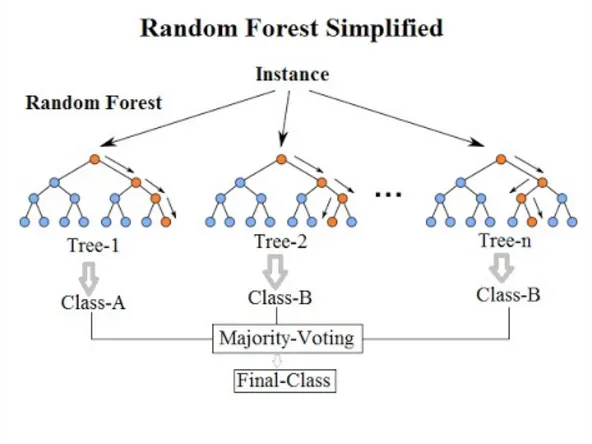
RANDOM FOREST
➢ Understanding the Decision Tree & Bagging ➢ Math behind Classification and Regression in tree ➢ Decision Tree concepts ➢ Using Random Forest for Regression ➢ K fold Cross Validation ➢ Model Optimizers ➢ Hyper parameter Tuning ➢ Building aDecision TreesModel in R
NAÏVE BAYES THEOREM
➢ Understanding the Naïve Bayes theorem ➢ Bayesian Vs Gaussian theorems ➢ Using naïve Bayes for Regression ➢ Model Optimizers ➢ Hyper parameter Tuning
NLP FOR MACHINE LEARNING FEATURING
➢ Label Encoding ➢ One hot encoding ➢ Synonym treatment ➢ Stemming ➢ Lemmatization ➢ Stop words ➢ Parts Of Speech Tagging ➢ TF-IDF and its math Behind
SUPPORT VECTOR MACHINE
➢ Understanding the SVM Concept ➢ Hyper plane and Kernel ➢ Using SVM for Regression ➢ Grid Search ➢ Model Optimizers ➢ Hyper parameter Tuning
GRADIENT BOOSTING MACHINE & XGBOOST
➢ Understanding the Boosting Concept ➢ Hyper plane and Kernel ➢ Learning Rate ➢ Model Optimizers ➢ Hyper parameter Tuning
K MEANS CLUSTERING ALGORITHM
➢ Understanding Nearest Neighbors concept ➢ Statistics behind K Means Clustering Algorithm
KERAS TENSOR FLOW – MLP DEEP LEARNING (NEURAL NETWORKS)
➢ Understanding Deep learning ➢ MLP Vs other Deep Learning ➢ How Neural Network works & Architecture ➢ Activation functions. ➢ Model Optimizers ➢ Hyper parameter Tuning ➢ Best Practice and when to use DL
H2O.AI
➢ Introduction to H20.ai ➢ Pros and Cons ➢ Available models in H20.ai
SAMPLING & DIMENSION REDUCTION (DR)
➢ Introduction to Sampling ➢ Over sampling and Under sampling ➢ SMOTE/SMOTENC & Near Miss ➢ Pros and Cons of sampling ➢ Introduction to DR ➢ PCA & it’s code
DEPLOYMENT OF MODEL TO PRODUCTION
➢ Introduction to Pyinstaller ➢ Pickle and Joblib
TABLEAU BASICS
➢ Introduction to Tableau ➢ Data sources ➢ Exploratory Data Analysis ➢ Clustering Analysis and Inferences using Tableau ➢ Creating visualizations
ADDED FEATURES
➢ Resume Preparation ➢ Resume Preparation Tips ➢ Sample Resumes ➢ Soft copy of Notes for each module ➢ 4 case studies on use case diagrams & 2 Real-time project specifications